What Happens to Frontline Performance When Young Leaders Are Asked to Coach Without Training?
When young leaders are asked to coach without formal training, frontline performance often suffers. The coaching continuum offers a clear path forward. It helps leaders understand what kind of coaching a situation requires and provides a roadmap for building capability in others. Here is how young leaders can become effective coaches, even if they are still learning the craft.
1. Understand the Coaching Continuum
The coaching continuum ranges from informal nudges to more structured coaching conversations. Knowing where you are on this continuum matters. It helps young leaders match their approach to the moment and respond with clarity instead of reacting inconsistently.
Key takeaway: Awareness drives accuracy. The continuum gives leaders a structure to coach with intention.
2. Start with Connection
Connection is the starting point in the coaching continuum. Before giving feedback, young leaders must build rapport and trust. This means understanding strengths, challenges, and motivations, and showing genuine interest in someone’s development.
Key takeaway: Connection creates openness. Without it, coaching feels like criticism instead of growth.
3. Observe and Assess
After establishing trust, leaders need to observe real behavior. Watch decisions, actions, and outcomes. Assess them against expectations. This prevents guesswork and ensures feedback is grounded in facts rather than impressions.
Key takeaway: Observation creates clarity. Leaders cannot coach what they cannot see.
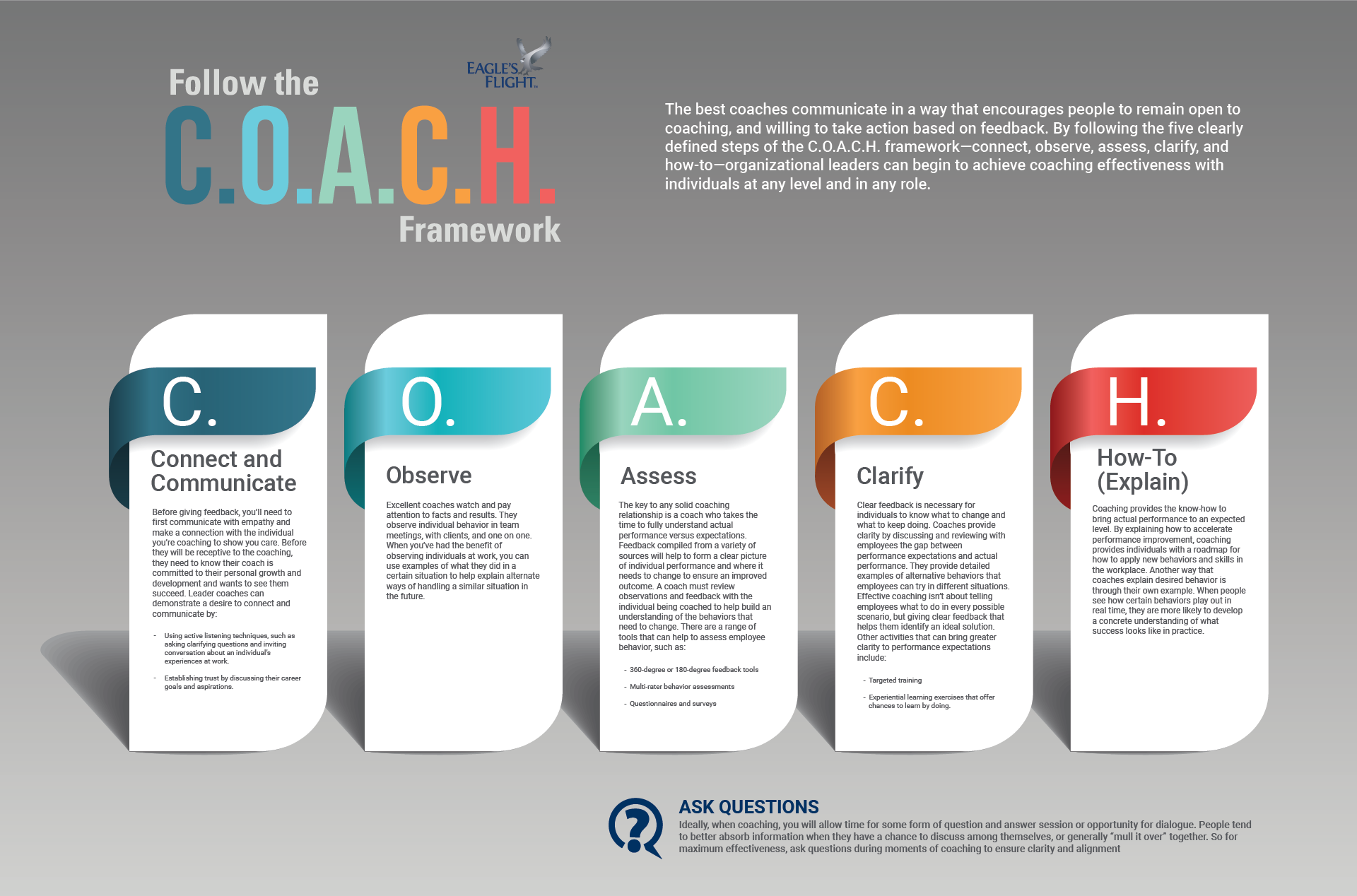
4. Provide Clear Feedback Using the COACH Framework
The COACH framework is part of Eagle’s Flight’s leadership development methodology and provides a simple structure for effective feedback:
Connect: Reinforce the relationship and shared interest in improvement.
Observe: Share the specific behavior you saw.
Assess: Explain how the behavior aligns with expectations.
Clarify: Outline what needs to change and why.
How: Offer practical steps for improvement.
Key takeaway: Structure reduces anxiety. COACH makes conversations clear and actionable.
5. Encourage Self-Reflection
Self-reflection helps team members take ownership of their improvement. Ask questions that prompt them to evaluate their choices and results. People commit more deeply to insights they discover themselves.
Key takeaway: Reflection drives responsibility.
6. Support Skill Development
Coaching is not just about addressing gaps. It is about building capability and skill improvement. Identify training, resources, or mentors that support the skills your team members need to grow.
Key takeaway: Development requires support, not just feedback.
7. Foster a Growth Mindset
Encourage people to view mistakes and challenges as opportunities to learn. A growth mindset strengthens resilience and momentum across the team.
Key takeaway: Mindset shapes performance.
8. Measure Progress and Adjust
Effective coaching is ongoing. Set clear goals, track progress, and adjust your approach when needed. Celebrate wins and address barriers early.
Key takeaway: Measurement creates movement. What gets tracked gets better.
Pitfalls to Avoid
Inconsistency: Coaching should be regular, not occasional.
Overemphasis on criticism: Balance correction with development.
Ignoring individual differences: Tailor coaching to the person, not the leader’s preference.
Action to Take Today
Start with a one-on-one conversation. Ask about goals, challenges, and what support would be most helpful. Use this moment to connect, observe, and begin coaching intentionally.
When young leaders use the coaching continuum and the COACH framework consistently, frontline performance strengthens, confidence grows, and the entire team benefits.
FAQ: Coaching When You Are a Young or New Leader
The Coaching Continuum and COACH framework referenced below are part of Eagle’s Flight’s leadership development methodology.
1. What is the coaching continuum?
A model that outlines the full range of coaching interactions, from informal nudges to more structured conversations. It helps leaders choose the right approach for each situation.
2. Why do young leaders struggle with coaching?
They were promoted for performance, not for coaching. Without a clear process like the coaching continuum or COACH framework, they rely on instinct, which leads to inconsistent results.
3. Why does connection matter before coaching?
Connection creates trust. Trust opens the door to honest coaching conversations. Without connection, feedback feels like correction instead of support.
4. How do I observe performance effectively?
Watch real behavior, use objective criteria, and look for patterns. Observing before coaching increases accuracy and fairness.
5. What is the COACH framework?
A structured feedback tool used in Eagle’s Flight programs:
Connect
Observe
Assess
Clarify
How
It makes feedback easier to give and easier to act on.
6. How do I help people take ownership of their improvement?
Ask open-ended questions. Encourage reflection. Let them identify gaps and propose solutions.
7. What if a team member does not respond to coaching?
Review expectations, strengthen connection, and choose the next step on the coaching continuum. Some situations require a more structured conversation.
8. How often should I coach my team?
Short, frequent coaching interactions create stronger behavior change than occasional long conversations.
9. How do I tailor coaching to different people?
Learn each person’s strengths, motivators, and learning preferences. Adjust your style to match their needs.
10. How do young leaders know if their coaching is working?
Look for improved decisions, increased ownership, stronger consistency, and progress toward goals.
11. What is the biggest mistake new coaches make?
Solving the problem for the person instead of developing their ability to solve it.
12. What is one action I can take today to become a better coach?
Have a focused one-on-one conversation. Understand goals and challenges, and use it as the starting point for intentional coaching.